In this article
- Four questions
- 1. Be honest about the real job
- 2. Build backwards from the behaviour
- 3. Choose the right partnership model, not just the right property
- 4. Find the permission before the platform
- 5. Stop confusing fan passion with sponsor relevance
- 6. Build around the value only each side can unlock
- 7. Design for adoption before you design the launch
- So, what does partnership heaven look like?
I have spent a lot of my career sitting in the space between brands and sport. At P&G and Hilton, I saw how brands think about growth, customers, budgets, risk and internal pressure. At The FA, ECB, BUCS and now through Bazballers, I have seen how rights holders think about assets, audiences, participation, content and commercial value.
The funny thing is that both sides usually want the same thing. A partnership that works. They just often start from completely different places.
Brands can be guilty of seeing sport as a shortcut to attention. Rights holders can be guilty of assuming attention is enough. Somewhere between the two is where the high-performing partnerships live.
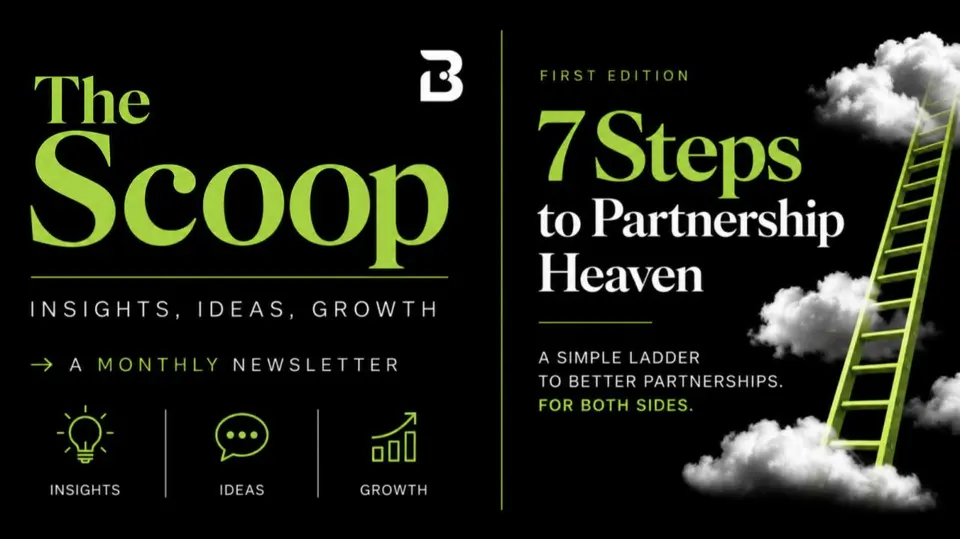
That is what I wanted the first edition of The Scoop to explore. Not as a perfect theory. More as a practical field guide.
Four questions
The way I think about it is through four questions, which is now our [4P model](/4p-model/):
- Purpose – what is the partnership truly for?
- Proposition – what are we building around the audience, assets and activation?
- Positioning – why does the brand have permission to play this role?
- Performance – how will we know whether it worked?
Most partnership problems tend to sit in one of those four places. The purpose is sometimes vague or not accurately defined. The proposition is generic. The positioning is weak and fails to engage the intended audience. Or the performance story is unclear, unrealistic or measures are set part-way through the term.
The word partnership also gets used a lot in sport. Sometimes it means sponsorship. Sometimes it means a logo package. Sometimes it means a rights fee with some activation wrapped around it.
But the more interesting opportunities are often broader than that.
They can be licensing deals. Product collaborations. Technology partnerships. Content partnerships. Distribution agreements. Data and CRM projects. Shared go-to-market plans. B2B relationship platforms. Participation programmes. Or commercial models where the brand helps the rights holder build new audiences and revenue streams.
That matters because the best partnerships should not only ask: what can the rights holder give the brand? They should also ask: what can the brand help the rights holder become?
So, with that in mind, here are my 7 steps to partnership heaven. The version where both sides create more value.
1. Be honest about the real job
A lot of partnership problems start because the stated objective and the real objective are not quite the same, and often it's not shared until it is being missed.
The brief says awareness. The CMO wants credibility. The sales team wants access. The CEO wants momentum. The board wants proof of growth. The brand team wants cultural relevance. The rights holder wants renewal.
None of those things are wrong. But they are not the same job. And partnerships get designed around the objective people are willing to say out loud, not always the one that actually decides whether the partnership survives.
A brand may say it wants to support the game when really it needs a more distinctive way to reach a new audience. A rights holder may say it wants a strategic partner when really it needs a partner that can bring distribution, capability, content, data or credibility. Again, neither is wrong. But if the real job is hidden, the partnership gets built on sand.
This is why the best partnerships are clearer from the start about the commercial, cultural or organisational job they are doing. Not just: what do we want this to do in market? Also: what does this need to prove internally?
- For brands: be honest about the business problem.
- For rights holders: be honest about the value you actually need from the partner.
2. Build backwards from the behaviour
This is where sponsorship can get lazy. The rights holder starts with the inventory. The brand starts with the budget. Then both sides try to force a strategy around what is available.
It should work the other way round. Start with the behaviour or perception you want to change, then build backwards.
If the job is fame, you need scale, repetition and a distinctive role in big moments. If the job is trust, you need credibility, proof, consistency and useful participation. If the job is trial, you need product experience, offers, sampling, CRM and a clean next step. If the job is loyalty, you need access, rewards, recognition and reasons for customers to feel closer to the brand. If the job is conversion, you need journeys, data, frictionless mechanics, attribution and a reason to act now.
The digital gap. This is where digital audience development changes the game. Sport used to be sold largely as attention: a crowd, a broadcast audience, a badge, a moment. Increasingly, rights holders also have social audiences, ticketing data, CRM, apps, content channels, ecommerce, membership products and community platforms. That means sport can do more than create awareness. It can move people from attention to action. But only if the partnership is designed that way. A brand cannot say it wants customer acquisition and then only buy visibility. A rights holder cannot say it can drive conversion and then only offer impressions.
That gap is where a lot of disappointment happens.
- Example: Google Pixel's work around women's football is a useful example. Pixel FC was not just the brand appearing beside the Lionesses. It used creators, content and the product itself to respond to a visibility gap in women's football coverage. The later Pixel FC Academy went further by helping young women break into football content creation and media. That is a different kind of role from simply buying awareness. It connects product, audience, content and progression.
Sport should not pretend to be Google Search. But it should stop pretending its only role is awareness.
- For brands: buy the assets that fit the behaviour you want, not the assets that are often lazily positioned at you.
- For rights holders: show how your channels, data and communities can change behaviour, not just deliver reach.
3. Choose the right partnership model, not just the right property
Not every partnership needs to be a classic sponsorship.
- Sometimes the better answer is a licensing deal, where the value sits in IP, product, retail and distribution.
- Sometimes it is a technology partnership, where the brand helps the rights holder improve the fan experience, operations, data, content or service.
- Sometimes it is a content partnership, where the value is in storytelling and audience development.
- Sometimes it is a participation partnership, where the brand helps grow the sport, not just borrow from it.
- Sometimes it is a B2B partnership, where the value sits in relationships, influence, hospitality, credibility and access.
- Sometimes it is a go-to-market partnership, where the brand uses its own customers, channels, stores, platforms or sales teams to help the rights holder reach new people.
That last point is under-discussed.
Rights holders often talk about the value of their audience to brands. But brands have audiences too. They have customers, retail networks, CRM databases, loyalty schemes, trade relationships, media budgets, influencer networks, product ecosystems and distribution channels. Used properly, those things can help the rights holder grow.
That might mean selling more tickets. Driving participation. Growing a women's team audience. Reaching students. Promoting a new competition. Building content reach. Creating retail products. Driving app downloads. Selling memberships. Or opening B2B relationships the rights holder could not easily access alone.
- Example: EA Sports and the Premier League is a good example of partnership extending beyond a badge. It is licensing, IP, product, fan behaviour and global reach. EA gets authenticity; the Premier League gets year-round presence inside one of football's most influential entertainment ecosystems.
- Example: Adobe and the Women's FA Cup is another useful example. The sponsorship was not only about naming rights. Adobe Express access and training were made available to hundreds of clubs, helping them create content and build closer connections with fans. Adobe gets a credible role in creativity. The competition and its clubs get capability they can actually use.
So the better partnership question is not just: how does the brand activate against the sport? It is: how do both sides bring their assets to market together?
- For brands: think beyond visibility.
- For rights holders: think beyond inventory.
4. Find the permission before the platform
Visibility is easy to buy. Permission is harder to earn. A brand can be seen in sport without having any meaningful reason to be there. That might still generate impressions, but it rarely creates much value beyond presence. The stronger partnerships answer a more interesting question: why does this brand have a role here?
Permission can come from product relevance. It can come from heritage. It can come from utility. It can come from audience need. It can come from shared values. It can come from making the experience better.
- Example: Mastercard and Priceless worked because access, experience and emotional moments were natural territory for the brand.
- Example: Guinness and rugby works because the brand has built memory, ritual and occasion over time. The extension into the Women's Six Nations also recognised the need to raise the profile of the players, working with social platforms to support player visibility.
- Example: Airbnb is supporting the WSL by offering an accommodation fund to support players as they relocate from one club to another.
The point is not that every partnership needs a grand social purpose. It does not. But it does need permission. Without it, the brand is just renting space.
- For brands: do not just ask whether the audience is attractive. Ask whether the brand has a credible role in their world.
- For rights holders: do not just sell the platform. Help the brand find the role it can own.
5. Stop confusing fan passion with sponsor relevance
Fans care deeply about the sport, club, event or athlete. That does not mean they care about the sponsor. This is where sponsorship logic can get sloppy. Rights holders sometimes overstate the transfer of emotion. Brands sometimes assume that borrowing passion means they have earned attention, trust or action. They have not.
The passion is real, but it belongs to the fan and the property first. The brand has to earn its way into that relationship.
- Sometimes that means adding utility.
- Sometimes it means creating access.
- Sometimes it means solving a problem.
- Sometimes it means making the experience better.
- Sometimes it means knowing when to stay quiet and not overclaim.
- Example: Barclays in women's football is a good example of a brand trying to do more than borrow the audience. The sponsorship of the Women's Super League mattered, but the broader commitment to girls' access to football in schools gave the partnership a role beyond visibility. The Barclays Girls' Football School Partnerships have been positioned around equal access to football in schools, with the programme scaling from thousands of schools to more than 20,000 participating schools by 2024.
- Example: Metro Bank has supported the growth of women's and girls' cricket through a fund that helps to put the right people in place to support participation.
That is the sort of proof point that changes the partnership from "we are next to this" to "we are helping this move forward". This is where the rights holder's audience understanding matters.
- A financial services brand in university sport should not just say, students love sport. It needs to ask what student athletes actually need: confidence with money, first-job support, travel, budgeting, insurance, wellbeing, rewards or career transitions.
- A tech brand in football should not just say, fans love data. It needs to make the data useful, entertaining or part of the way fans understand the game.
- A brand in grassroots sport should not just borrow community credibility. It needs to be seen helping the community in a way people recognise.
- For brands: earn relevance before asking for action.
- For rights holders: protect the fan relationship by being clear on what good partners should add.
6. Build around the value only each side can unlock
Not all assets are equal. Some are visible. Some are valuable. The best ones are often both, but not always. A club may sell perimeter boards, social posts and tickets. But its real advantage might be local trust, player access, matchday ritual or a community role that no national media buy can replicate.
A governing body may sell logo rights and event presence. But its deeper advantage might be credibility, participation pathways, schools access, coaching networks or the ability to shape behaviour at scale.
A university sport body may not have the biggest audience in sport. But it may have access to a life stage where habits, friendships, identity and future purchasing patterns are still being formed.
Women's sport is not just attractive because it is growing. It is attractive because brands can still help shape the culture, not merely buy into one that is already fully formed.
But this cuts both ways. The brand also has assets. Customers. Channels. Data. Technology. Product. Retail reach. Media spend. Loyalty programmes. Sales teams. B2B relationships. Creator networks. Expertise.
The most interesting partnerships are often the ones where both sides ask what they can unlock for each other.
- Example: DHL and Formula 1 is a strong B2B example. DHL is not just buying visibility in a sport with global reach. It has a credible operational role in moving Formula 1 around the world, which demonstrates the complexity and capability of its logistics business. The service is not adjacent to the sport. It is part of the sport working.
- Example: Salesforce and Formula 1 is another useful example because it is not just a badge on the sport. F1 has used Salesforce to support fan engagement through data, CRM and now AI-powered fan experiences. The value exchange is much broader than exposure: F1 improves fan journeys and Salesforce gets a high-profile proof point for its technology.
That is the opportunity.
The partnership is not just a rights-holder asset being sold to a brand. It is a combined value system. One side may bring audience, emotion, credibility and IP. The other may bring product, technology, distribution, customers, data, expertise or routes to market.
When those things join up, the partnership becomes harder to copy. And often more useful to both sides.
- For brands: do not only ask what you can take from the property. Ask what you can help the property build.
- For rights holders: do not only value the fee. Value the partner's channels, customers, capability and go-to-market power.
7. Design for adoption before you design the launch
A partnership can look great externally and still fail internally. This happens more often than people admit. The launch is good. The announcement lands. The logo is visible. The content looks fine. But inside the brand, nobody really knows how to use it.
- Sales do not know how it helps conversations.
- CRM does not have a journey.
- Retail does not have a reason to care.
- PR gets brought in too late.
- Social treats it as an asset delivery job.
- Leadership only pays attention at renewal.
- The agency has the rights deck, but not the business context.
Then, 18 months later, everyone asks why the partnership did not work harder. This is where my brand-side experience has probably shaped my view most. The best partnerships are not just activated. They are adopted.
More teams understand what the partnership is for. More teams know how to use it. More teams can see how it helps them achieve something they already care about.
For a B2B brand, that might mean client hosting, account development, thought leadership, introductions and sales enablement.
For a consumer brand, it might mean shopper, social, CRM, ecommerce, PR, creators and product all working from the same idea.
For a destination, it might mean tourism, airlines, events, hospitality and inward investment joining up.
This is also where rights holders can be much more valuable. Not by doing the brand's job for them, but by helping more parts of the brand understand how the partnership can work.
- For brands: plan internal adoption as deliberately as external activation.
- For rights holders: help the brand sell the partnership internally, not just launch it externally.
The review and renewal story
There is one final part of adoption. Most partnerships are measured too late. Not because there is no data. There is usually plenty. The problem is that the data does not always ladder into a story that helps the partnership survive. I am a strong advocate of measuring and reviewing deeply at least twice a year (I know!), because business and sport change so fast that you need to remain agile.
Reach, engagement, brand lift, sales, leads, redemptions, PR value, sentiment, hospitality value, participation numbers and content views can all be useful. But none of them matter equally in every partnership. And none of them save you if the original objective was vague.
The review and renewal story should be shaped before the partnership goes live, and updated throughout:
- What did we set out to change?
- Which audiences mattered?
- What role did sport play?
- Which assets worked hardest?
- What did we learn?
- What value was created?
- What would we do differently next time?
- Why does this deserve more time, more budget or more ambition?
That final question matters because the best partnerships often compound. The audience starts to understand the association. The brand becomes more fluent. The rights holder learns what works. The activation gets sharper and drives increasing ROI.
So, what does partnership heaven look like?
Probably not heaven, to be honest. Most partnerships are too messy for that.
There are competing objectives, changing budgets, internal politics, rights issues, stakeholder pressure, player availability, agency handovers, late approvals, measurement debates and the occasional campaign that made perfect sense in the meeting but less sense in the real world.
But the better partnerships do tend to have a few things in common.
They know what job they are doing. They are built around the right behaviour, not just the available assets. They choose the right partnership model. They give the brand a credible role. They respect the fan relationship. They use the value only each side can unlock. They are adopted inside the business. And they have a commercial story that people can understand.
The best partnerships are not just bought. They are designed together, you know... like a partnership!
And increasingly, they are not just sponsorships. They are shared growth platforms. That is why partnership, done well, is still one of the most interesting parts of marketing. Because sport can create attention, emotion, trust, community, culture and behaviour change. But the best partners can also bring something back into sport: capability, distribution, creativity, data, product, investment and new audiences.
That is where the opportunity gets much bigger, and where the word partnership starts to mean what it should have meant all along.
First published on LinkedIn on 5 Jul 2026. Read the original
Russell James
Founder of Bazballers. Formerly Marketing Director at The FA, Sales and Marketing Director at the ECB, and ten years at P&G.
More about Russell